
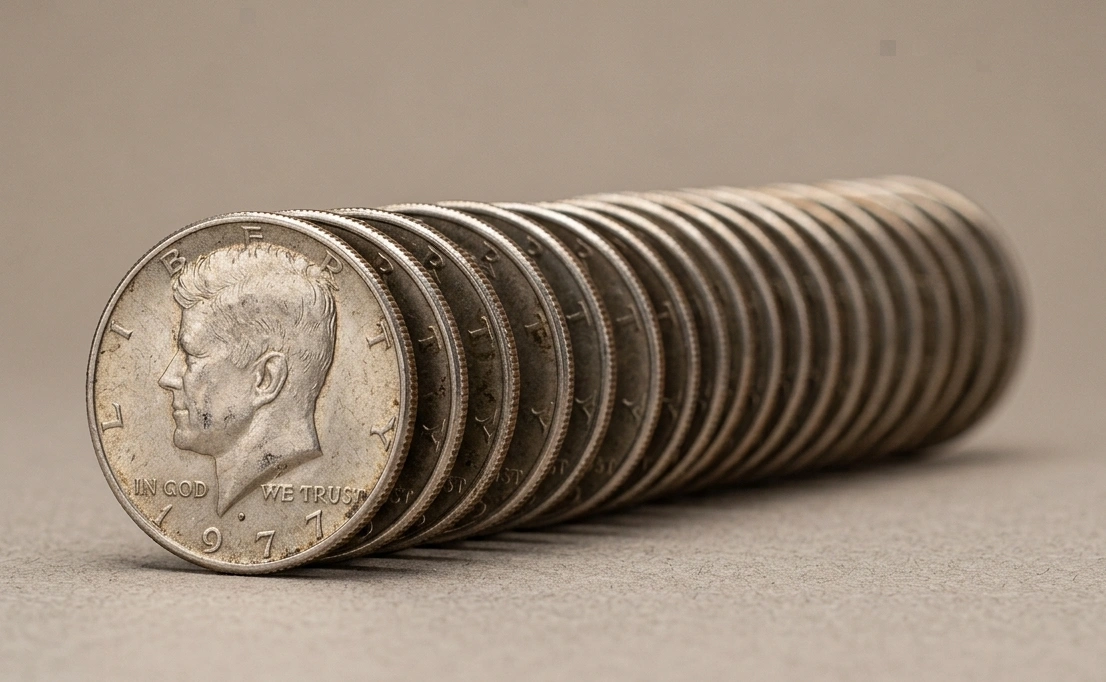
Production-to-packaging journeys follow a structure far stricter than most people realize.
So, how many coins in a roll of half dollars?
Coin Characteristic | Standard Value |
Modern Sample Mass | 11.34 grams |
Disk Diameter | 30.61 mm |
Edge Thickness | 2.15 mm |
Metal Composition | Copper and Nickel |
Edge Reeds | 150 units |
High-precision sensors ensure that defective specimens are discarded prior to packaging.
Sealed rolls weigh exactly 226.80 grams excluding the mass of the wrapping paper.
Any deviation from this weight signals the presence of different coin types or blank defects.
Currency movement within the facility is divided into strictly controlled access zones.
Transfer Cycle → Press Output → Collection Hopper → Conveyor Belt → Automatic Scales → Wrapping Unit.
Blanks arrive at the striking floor in massive containers known as ballistic bags.
One such bag holds approximately 50,000 coins with a total mass exceeding 560 kilograms.
Organizing coins into rolls simplifies inventory management within Federal Reserve vaults.
Two primary packaging types remain in use throughout 2026.
Original Mint Rolls
These feature specific branding and tight machine-crimped edges. Paper wrappers indicate the mint of origin: Philadelphia (P) or Denver (D).
Third-Party Bank Rolls
Private armored car companies like Loomis or Brinks handle these. Contents often include mixed years, including older Silver specimens.
One standard roll contains 20 coins with a total face value of 10.00 $.
Roll prices in 2026 depend on origin and the date of formation.
Value growth for 2012-dated 50-cent rolls (limited to collector mintage):
2024 Price: 38.00 $* 2025 Price: 41.50$
2026 Price: 46.00 $
Annual price increases average 8-10% due to the steady contraction of market supply.
Investors view intact paper wrappers as a guarantee against prior searching of the contents.
Glory and Cummins packaging lines achieve speeds of up to 40 rolls per minute.
Mechanical calibration involves several distinct stages.
→ Separating the bulk flow into single rows → Counting 20 units using optical sensors → Forming a cylindrical stack → Wrapping in kraft paper under high pressure → Thermal marking application
Counting accuracy reaches 99.99%, eliminating shortages in bank deliveries.
Neural networks were added to these systems in 2026 to detect soiled or deformed coins.
Equipment failures occasionally create unique lots highly valued at auctions.
Rolls with visible minting errors on the end coins attract significant attention.
Lot Type | Condition | Sale Price | Date |
1964 Roll (Both Ends Obverse) | UNC | 580.00 $ | Jan 2026 |
Franklin Coin on End | MS64 | 1,450.00 $ | Mar 2026 |
Kennedy Roll (Paper Cut Error) | BU | 320.00 $ | Apr 2026 |
Packaging defects occur in less than 0.001% of cases, making such items extremely rare.
A roll displaying a 1964 Silver coin on the end fetches 50 times its face value.
Half dollar organization history reflects the broader economic transformations of the US.
Cause of Change → Global price increases for precious metals.
Result → Transitioning from 90% Silver to Copper-Nickel cladding in 1971.
Pre-1964: 250.00g roll mass, containing 225.00g of Silver
1965–1970: 230.00g roll mass, containing 92.00g of Silver
1971–2026: 226.80g roll mass, zero Silver in circulation issues
Monitoring roll weight allows for rapid identification of Silver content without opening the paper.
Portable scales with 0.01-gram precision are the primary tool for field appraisal in 2026.
Roll organization provides basic protection against mechanical damage.
However, paper packaging is not airtight and permits moisture entry.
End Toning
Chemical reaction between the metal and sulfur found in the paper. This creates rainbow patterns that can increase a coin's value by 20-30%, that’s why collectors regularly check their items with the coin identifier app.
Coin Welding
Outcome of long-term storage in damp bank vaults. Corrosion leads to the loss of numismatic value for the entire roll.
Paper Mildew
Indicating poor storage conditions and potential surface damage to the coins.
Acrylic capsules are used in 2026 to protect high-value rolls from the elements.
Financial efficiency analysis for bank-wrapped sets from 2021 to 2026.
Walking Liberty Rolls (Assembled) → 145% price growth
Original 1964 Kennedy Rolls → 82% price growth
Modern 2000s Rolls → 15% price growth
Numismatic premiums for untouched rolls exceed the combined value of the individual coins inside.
Potential for finding a perfect MS67 specimen creates a "lottery effect" for buyers.
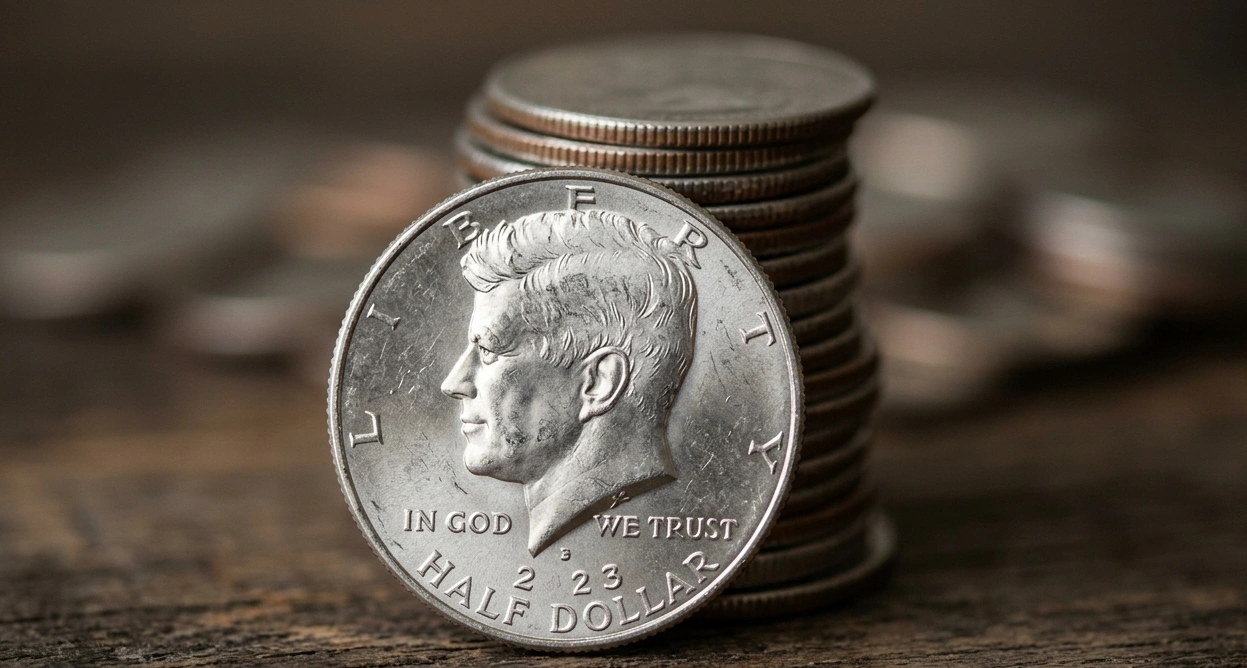
Rolls are grouped into cardboard boxes for wholesale delivery to financial institutions.
A standard half dollar box contains 50 rolls.
→ Total coin count: 1,000 units → Box face value: 500.00 $ → Gross mass: 11.50 kilograms → Marking type: Color-coded stripes (usually black or yellow)
Boxes are sealed with polymer tape featuring delivery service logos.
RFID tags track most boxes in 2026 to prevent theft during transit.
You can also scan them and keep them in the digital collection via a Free Coin Identifier And Value App.
Coins with the 'S' mark occupy a unique tier in the packaging hierarchy.
These are struck in mirror-like quality and usually packaged in individual plastic cases.
Rarely, these coins enter general rolls when private collections are liquidated.
A single Proof 'S' coin found in a 2026 bank roll is valued at 6.50 $.
Discovery rates for San Francisco coins in general circulation are 1 in 1,200 specimens.
Organized crime leverages the high value of rare rolls to create fakes.
Falsification methods in 2026:
Utilizing modern equipment to mimic vintage machine crimping.
Placing cheap coins in the middle of a roll while keeping rare dates on the ends.
Treating new paper with chemicals to simulate aging.
Professional appraisals include ultrasonic scanning to confirm the consistency of the contents.
Large centers in Chicago charge 45.00 $ per roll for this verification service.
Finding a Silver coin in a standard bank roll is extremely unlikely in 2026.
Sorting statistics from 10,000 rolls in 2025:
90% Silver Coins (pre-1964) → 1 per 850 rolls
40% Silver Coins (1965–1970) → 1 per 110 rolls
1976 Commemorative Coins (Copper-Nickel) → 1 per 15 rolls
Total volume of "wild" Silver in the bank system decreases by 12% annually.
Automated sorters in cash processing centers drive this steady decline.